

When Families Go To Court Too Soon
There is an old saying often attributed to Abraham Maslow: “If the only tool you have is a hammer, every problem looks like a nail.” It is sometimes called Maslow’s Hammer or the law of the instrument—the tendency to rely on the tool we know best, even when the problem in front of us calls for something different.
There is nothing wrong with a hammer. I love to hammer. In fact, when you have a nail, a hammer is exactly what you want! The problem comes when we start treating every problem as though it were a nail. Family conflict is a good example.
Litigation Is an Important Tool. But It Is Still Just One Tool.
There are circumstances in which litigation is necessary. When a child is objectively unsafe, when a parent is refusing to comply with agreements or court orders, when there is unacknowledged domestic violence, when someone is hiding assets, or when the parties simply cannot reach a resolution despite meaningful efforts to do so, the authority of a court can be essential. Litigators play an important role in those circumstances. A good litigator knows how to protect a client's interests, navigate the court system, build a case, and advocate effectively when a judge needs to make the decision.
But not every family law problem is a nail. And that raises an important question: What happens when the first professional someone consults has spent years honing litigation as their only tool? This isn't a criticism of litigators - I was a litigator. It is a question about perspective:
If you go to a carpenter, she is probably going to advise that the project needs a hammer.
If you go to a surgeon, the conversation is probably going to include surgery.
If you go to a litigator about a family problem, litigation is naturally going to be part of the conversation.
That doesn't mean the professional is doing anything wrong. It means that the tools we know best tend to shape the solutions we see.
What If the Problem Isn't a Nail?
Consider two parents who are separating.
They both love their children. Neither is abusive. Neither is withholding the children from the other. They disagree—sometimes/often strongly—about schedules, holidays, school decisions, expenses, communication, and what their lives should look like after separation. They have a house, retirement, and investment accounts. They both want the house and are stuck in the same conversations about who should move out, but no one has changed the locks or secreted away funds.
They are frustrated. They may not trust each other a whole lot. They may not be communicating well. But they are also capable parents who will need to work together for years to come. Their problem is real, painful, and often urgent.
But is it a nail?
Starting with litigation can change or even exacerbate the nature of the problem.
A disagreement about Thanksgiving can become a legal dispute about parenting time. A disagreement about expenses can become a claim for reimbursement. A communication problem can become an allegation in a pleading. A parent who feels unheard may begin looking for evidence against the other parent rather than looking for a way to solve the problem. And once the machinery of litigation begins, it can be difficult to step back from it.
Not because anyone necessarily intended for things to become so adversarial. Sometimes it simply happens because the process itself begins to define the problem.
The First Question Shouldn't Always Be, “Who is right?”
For many families navigating separation and divorce, the question is not “who is right?” but rather “what does this family need in order to move forward?”
What I’ve learned is that we family law lawyers were trained to fight first and ask questions about what the fight was doing to the family later, if at all. It took years of seeing what the fight costs families for me I realize that there are far fewer nails out there than I’d been trained to believe.
That doesn’t mean litigation should always be avoided. It means it shouldn’t necessarily be the starting point or even the first tool offered (threatened) when two folks are at a standstill. Instead of jumping immediately to the most adversarial, costly, drawn out legal process first, what many families need are processes like Collaborative Divorce, Mediation, settlement conferences, therapy, financial advice, and/or simply enough time and structure for two people to have a productive conversation.
The point isn't that one process is always better than another. The point is that too often, separating spouses don’t know what their process options are. They assume that separation and divorce inevitably include litigation unless they are the exceptionally amicable couple who already has everything figured out and plan to remain best friends.
The truth is that most of the clients I represent in a collaborative process are as hurt, upset, and angry as those at the beginning stages of litigation. What is different are the strategies we use to address the issues in their cases. Instead of using conflict as the vehicle for resolution, we work to create a container that allows people to make decisions about their own families while still having the support, information, and legal guidance they need.
The Cost of the Wrong Tool
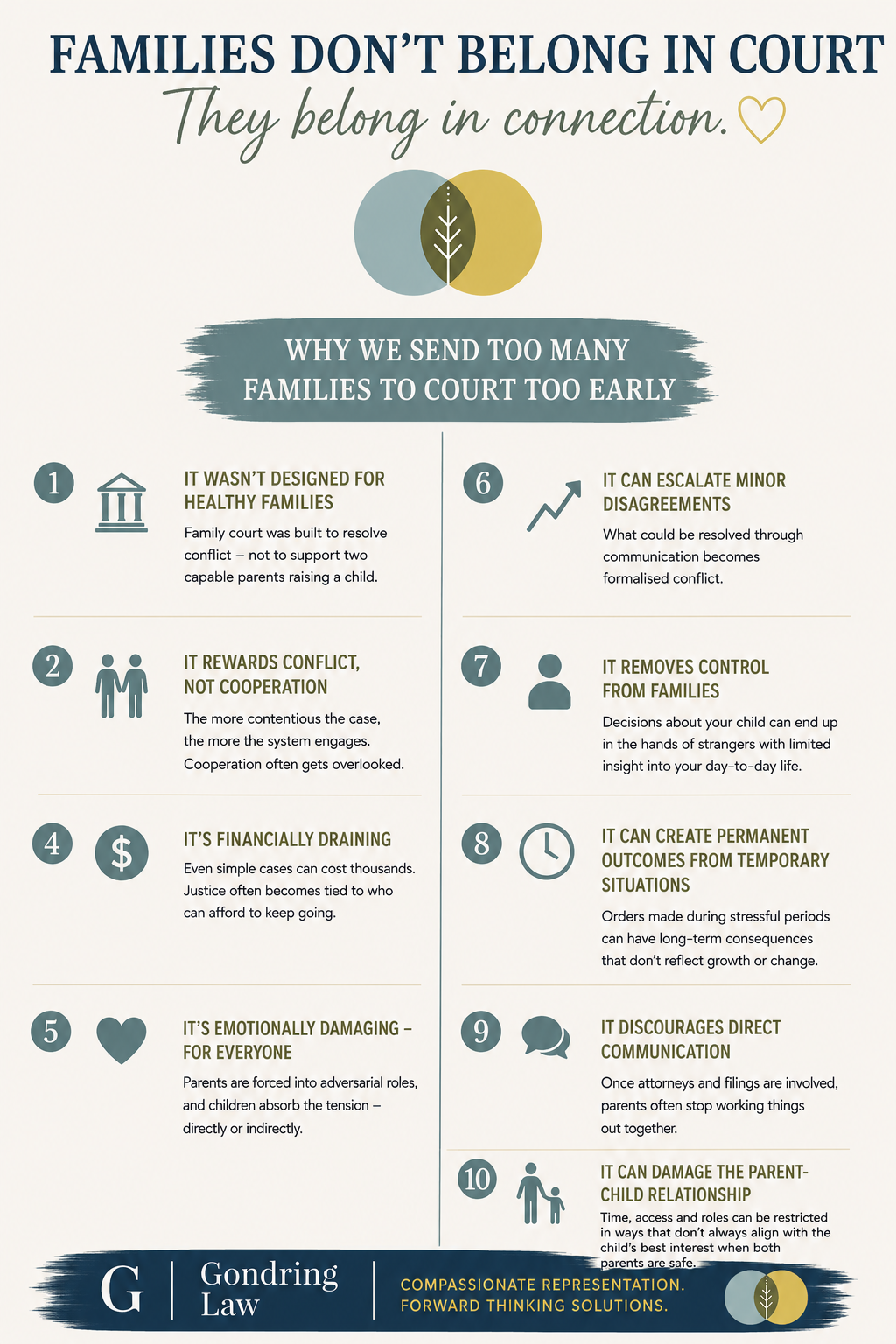
The consequences of starting with unnecessary litigation aren't limited to attorney fees. Litigation can create an environment in which parents begin seeing one another as opponents rather than as two people who will continue to share responsibility for their children. It can make direct communication more difficult. It can encourage parents to document rather than discuss. It can turn temporary disagreements into permanent positions. And, in some cases, it can place decisions about a family's day-to-day life in the hands of people who know the family primarily through documents, testimony, and evidence.
We Start With the Family, Then Decide the Process.
Families deserve to understand their options before choosing a process that may shape their relationships, their finances, and their children's lives for years to come. They deserve to know that there is a difference between being amicable and being able to collaborate. You don’t have to agree on everything. You don’t have to trust each other completely. You don’t have to be friends. You simply have to be willing to consider that your spouse is not a nail.
When it comes to family law, not every problem is a nail and not every family needs a hammer. Our job is to help you determine what you and your changing family need in order to successfully get to the other side of one of life’s hardest transitions.
we fix things.