

Nesting: Benefits and Challenges
One of our clients shared recently that nesting wasn’t something she ever imagined herself doing. When her separation began, however, everything felt like it was shifting at once—her routines, her sense of financial security, and her entire identity. But one thing stayed absolutely clear: the children needed security, predictability, and safety. They needed a place that still felt like theirs in the midst of their parents’ messy middle.
That’s how nesting became their bridge.
When two spouses make the decision to separate, they have already done a tremendous amount of emotional labor to arrive at their decision. Then what happens? Who’s going to leave the house? Are they going to sell their marital home? Will the children have to switch schools? How will finances and custody work? The unknown during the time between deciding to separate and actually separating can create a tremendous amount of pressure and stress that weighs heavy on a strained relationship. Some of that pressure is often alleviated by the space that living apart brings. But what about the children?
At its core, nesting means that the children stay in the family home while the adults rotate in and out according to an agreed-upon schedule. Instead of the kids packing bags and bouncing between spaces, the parents do the moving. For many families, nesting provides a bridge between what was and what will be.
Essentially, family home becomes the “nest”—the stable center. One parent stays in the home for their parenting time while the other lives elsewhere, often in a temporary apartment, with friends or family, or in a short-term rental. Then they switch. The kids remain surrounded by familiar rooms, routines, and neighborhood rhythms.
This setup can feel gentler for children, especially early in a separation, when emotions are high and everything feels uncertain. It gives them continuity while the adults sort through the rest.
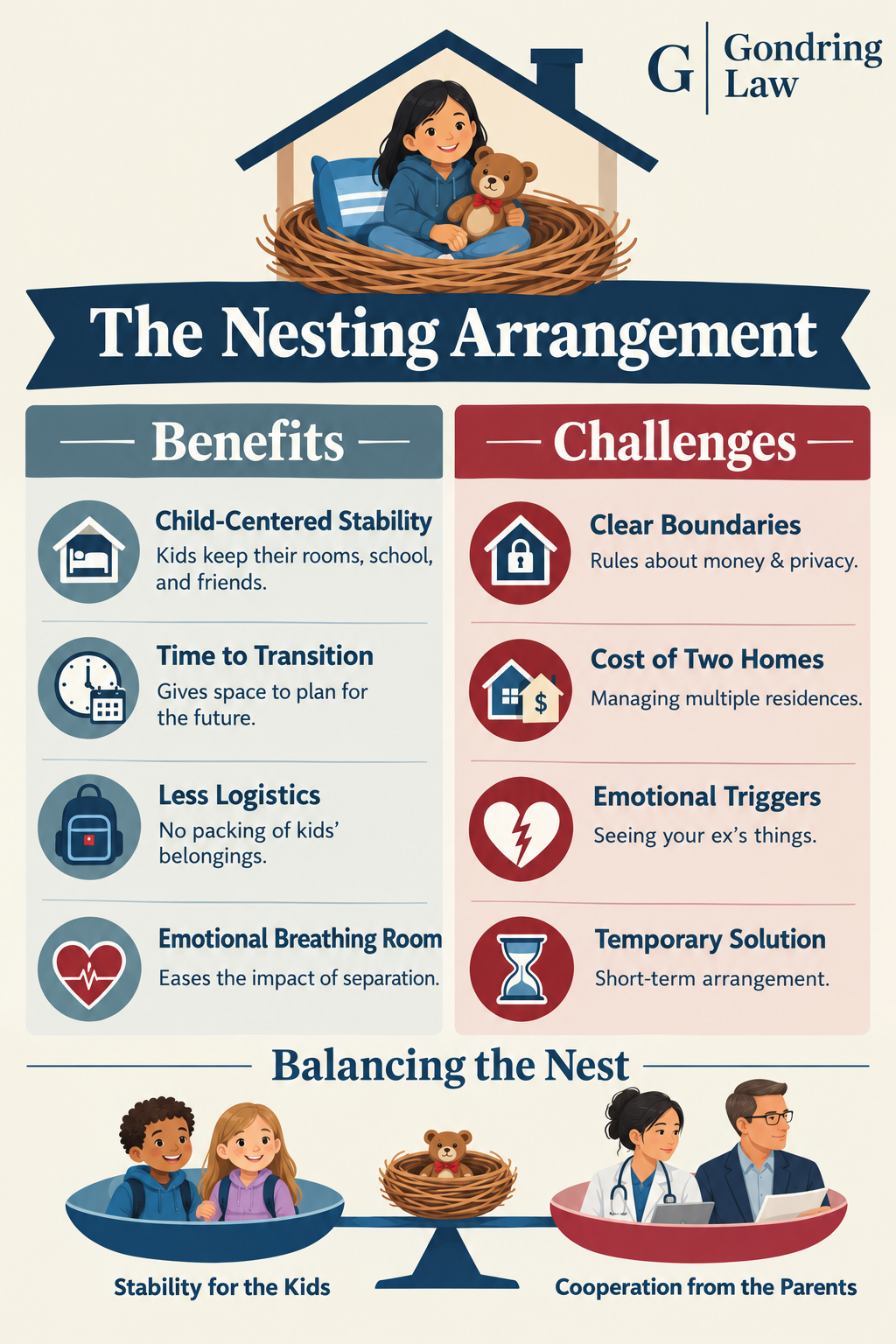
Benefits:
Child-centered stability — Kids keep their bedrooms, their school routines, their neighborhood friends. Their world stays intact even as the family structure shifts.
Time to transition — Nesting buys the adults time to make thoughtful decisions about housing, finances, and long-term custody arrangements. It often gives parents time to find permanent housing, alleviating the need for multiple housing transitions for the children.
Reduced logistical stress — No backpacks forgotten at the other parent’s house, no duplicate wardrobes, no constant shuffling.
Space for emotional processing — Nesting can soften the emotional impact of separation by giving the parents space from each other while keeping the children in their home.
Challenges:
Nesting isn’t simple. It requires structure, communication, and a willingness to collaborate even when the relationship is strained.
Clear boundaries — Many boundaries needs to be discussed, agreed upon, and honored. Questions like who pays for what, how is the home maintained, what’s private, and what’s shared all need to be determined in order for the arrangement to work.
Financial strain — Maintaining multiple living spaces can be expensive, particularly when the parents each rent a separate space. However, this piece can often be mitigated by the parents sharing a two bedroom apartment or living with friends or family when they are not attending to the children.
Emotional complexity — Seeing your ex’s belongings or navigating shared spaces can stir up a lot of feelings.
Temporary nature — Nesting is usually a short-term solution. Eventually, we see most families transition to more traditional co-parenting arrangements.
Nesting asks adults to hold two truths at once: We are separating, and we are still building a stable world for our children.
It’s a practice in maturity, patience, and compassion. It can feel strange, and it can also feel grounding. Many parents describe nesting as a way to honor their children’s needs while they work through their own healing.
Tips for Making Nesting Work
Develop a written agreement — Even if informal, clarity prevents conflict. We often help folks who are choosing this path but need some assistance in having the conversation. Help can look like developing the agreement within the safety of a Collaborative Conference or connecting you with a Co-Parenting Counselor.
Use shared tools — Calendars, expense trackers, and communication apps help keep things smooth.
Set emotional boundaries — Decide what conversations happen in the home and what happens elsewhere.
Plan the exit strategy — Nesting works best when there is a clear understanding of its duration.
Nesting isn’t for every family, but when it works, it offers something rare: a soft landing. It’s a way to protect childhood while adults navigate one of life’s hardest transitions. It’s imperfect, human, and often surprisingly hopeful.