

Holidays like Thanksgiving, Christmas, Hanukkah, and New Year's are full of rituals. The foods that we eat, the religious services we attend, the family that we gather with on a specific date, at a specific time, the way we exchange presents, the decorations that we use, and on and on and on. Some of the rituals we inherit from our family of origin, some we marry into with joy and excitement (others with a deep sigh), and still others we create.
Both my favorite holiday gatherings involve hiking. The first is the creatively named "New Year's Day Hike," which my parents started more than 30 years ago as a way to work off all of their New Year's Eve festivities (that's a nice way of saying they drank too much). All these years later, I still go with them up and over Stone Mountain, and it has become a tradition that my husband and children also cherish.
The second tradition, also creatively named the "Day After Thanksgiving Hike," was started in 2018 as a way to avoid Black Friday crowds and consumerism (if you love the deals, I remain forever awed by your ability to navigate humanity!). Unlike the challenge of the former, this hike is a meandering, nearly elevation-free, 1.5-mile stroll through the woods to a campsite where we build a fire, eat leftover turkey sandwiches, hot dogs, and s'mores, and breathe in the crisp pine air.
Obviously, I agree with Mary Oliver when she said, "If you have ever gone to the woods with me, I must love you very much."
So what would it mean to navigate these cherished traditions differently—or not at all?
I don't think there is a perfect way to spend the first holidays after separation, at least not logistically. Some people choose to postpone changing their traditions for a year or two, while others determine that changes to their traditions are needed immediately. Different people need different things.
For some, peace of mind means having one more Christmas morning with the children waking up and opening presents from Santa while both parents are present. For others, peace of mind means not having to navigate one more Christmas morning with tension that is palpable to everyone in attendance. And so it makes sense that separating spouses often have different ideas about how to navigate these big changes. It makes even more sense that when those strategies are different, the pain surrounding separation can become even more acute.
The good news is that there are ways to make it easier.
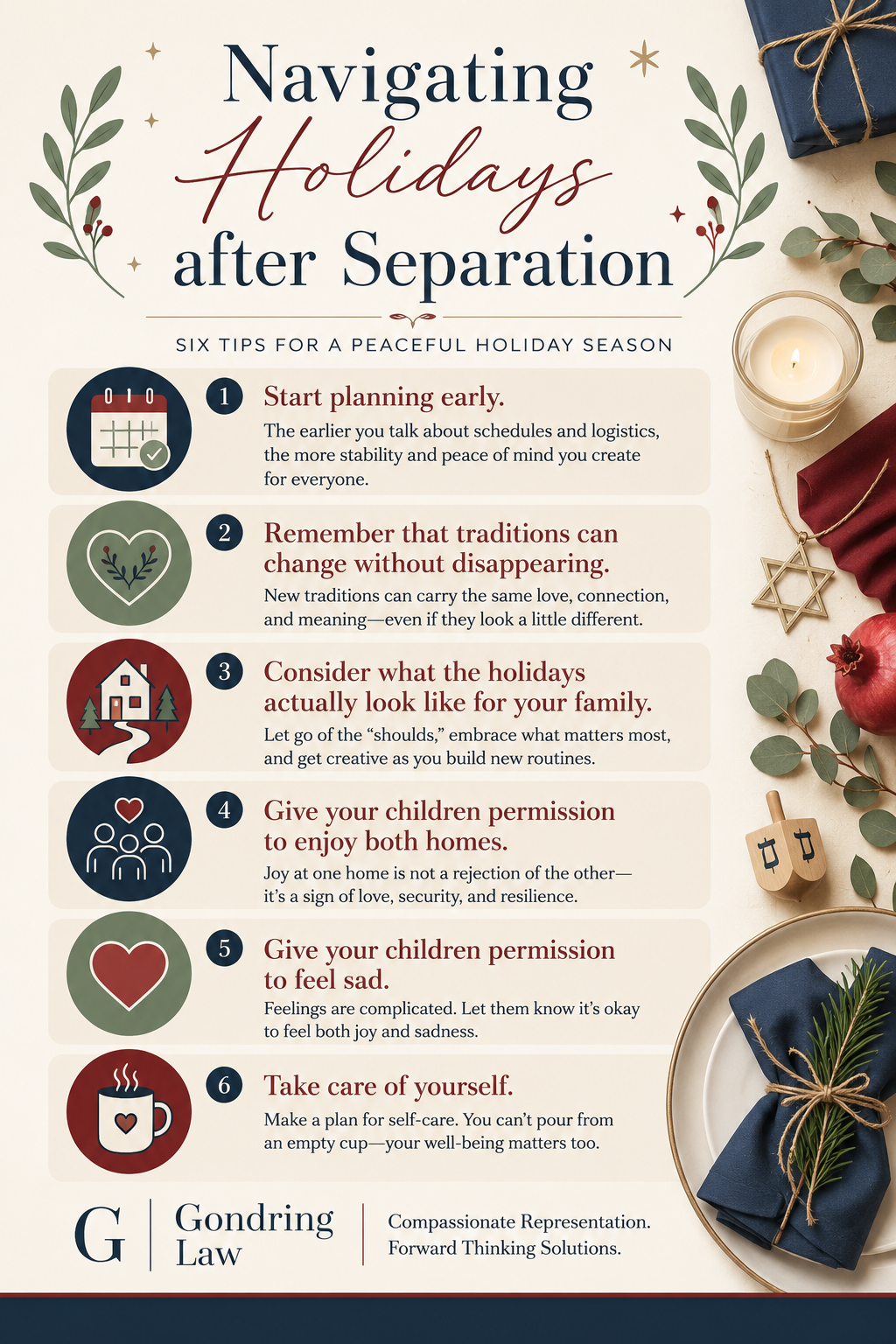
#1: Start planning early.
The worst time to figure out where and with whom the children are eating Thanksgiving lunch versus dinner is the day of. It is not much better to still be making a decision in the couple of days leading up to the event.
The earlier you talk about the logistics of the day, the easier it becomes to create stability, predictability, and peace of mind for everyone. Plus, you can get out in front of sweet Aunt Edna's mildly inappropriate questions about what is going on.
The earlier you start talking about these things and make decisions that everyone is able to live with, the better.
#2: Remember that traditions can change without disappearing.
Separation and divorce involve a loss that can feel akin to the death of a close family member. It is certainly appropriate to mourn that loss.
When both Grandma and Grandpa died in the fall of 2015, our traditions changed, but they did not disappear. To this day, we still use handmade name cards—this time, they are made by the children instead of Grandma. We still eat pie for dessert using my Grandma's oil-based crust recipe. It is just filled with pecans and pumpkin instead of mincemeat (Grandpa's favorite was no one else's favorite).
Maybe Dad has always made the pancakes on Christmas morning, and maybe at his house, in the years he's with the children, he still does. But in the years that Dad doesn't have the kiddos on Christmas morning, how can he incorporate the making of pancakes into the mix (you see what I did there, right)?
I'm convinced that what children remember most is the feeling associated with a tradition. Did it make them feel loved, cherished, and at home?
Traditions are about much more than what we do. They are about how those traditions make us feel.
#3: Consider what the holidays actually look like for your family.
Traditional holiday schedules—where parents split a holiday in half or alternate who gets what from year to year—might work beautifully for your family. On the other hand, maybe a New Year's Day Hike is infinitely more important to you than Christmas-morning present opening. It is okay (really!) to let go of the "shoulds," embrace what is actually most important to your family, and get creative as you restructure your family's traditions. There is no requirement that your post-separation holidays look like anyone else's.
#4: Give your children permission to enjoy both homes.
This may be the most important thing you can do for your children.
I think that sometimes parents are afraid that if their children enjoy themselves at the other parent's house, it somehow makes them obsolete. Yet, when our children enjoy themselves at a friend's sleepover, it isn't hard to recognize that their pleasure and excitement is exactly what we want for them.
If your kiddos come home excited about the presents they received, let them be excited!
If they share their joy about a new tradition, let them be joyful!
A wonderful time at the other parent's house is not a rejection of you. It is resilience. It is security. It is evidence that your child knows they are loved in both homes.
#5: Give your children permission to feel sad.
Feelings are complicated. Your child might simultaneously feel joy and sadness. Let them.
A reassuring hug paired with, "I missed you, too, and I'm so excited for us to celebrate together now," models that life is complicated, people are complex, and it is normal to feel all the feels. You don't have to talk your child out of their sadness. You can simply make room for it.
#6: Take care of yourself.
Holidays are actually a notoriously difficult time for many people.
Your first set of holidays after separation may be lonely, so it is a good time to make a proactive plan for self-care. Whether it is moving your body, spending time with friends and/or family, or taking some purposeful time for rest, remember that you don't have to prove that everything is fine.
It is okay if the holidays feel hard; it is okay if you are grieving; it is okay to enjoy yourself, too.
Transitions are hard. Over time, you will develop new traditions, and the holidays will become familiar again.
We're here to help you think through what you hope life will look like on the other side of separation and divorce. And we've learned that before we get to houses and retirement accounts, sometimes the most important issue to address is how to make Christmas morning feel good for both you and your children.